Competitive Landscape for
PMS Therapies
Some description text goes here…
Some call-to-action text description goes here..
[CtA button-1] • [ctA Button-2]
Jaguar Gene Therapy (JAG 201)
Addressing the genetic cause of PMS
-
What is JAG201?
JAG201 is an investigational gene therapy designed to address one of the underlying genetic causes of Phelan-McDermid syndrome: a missing or nonfunctioning copy of the SHANK3 gene.
SHANK3 plays an important role in communication between nerve cells in the brain. When this gene is missing or disrupted, it can contribute to challenges with communication, learning, movement, behavior, and other areas of development.
JAG201 uses a modified virus, called an AAV9 vector, to deliver a functional copy of SHANK3 to cells. The goal is to help restore SHANK3 function and potentially improve developmental outcomes.
-
Where does the research stand?
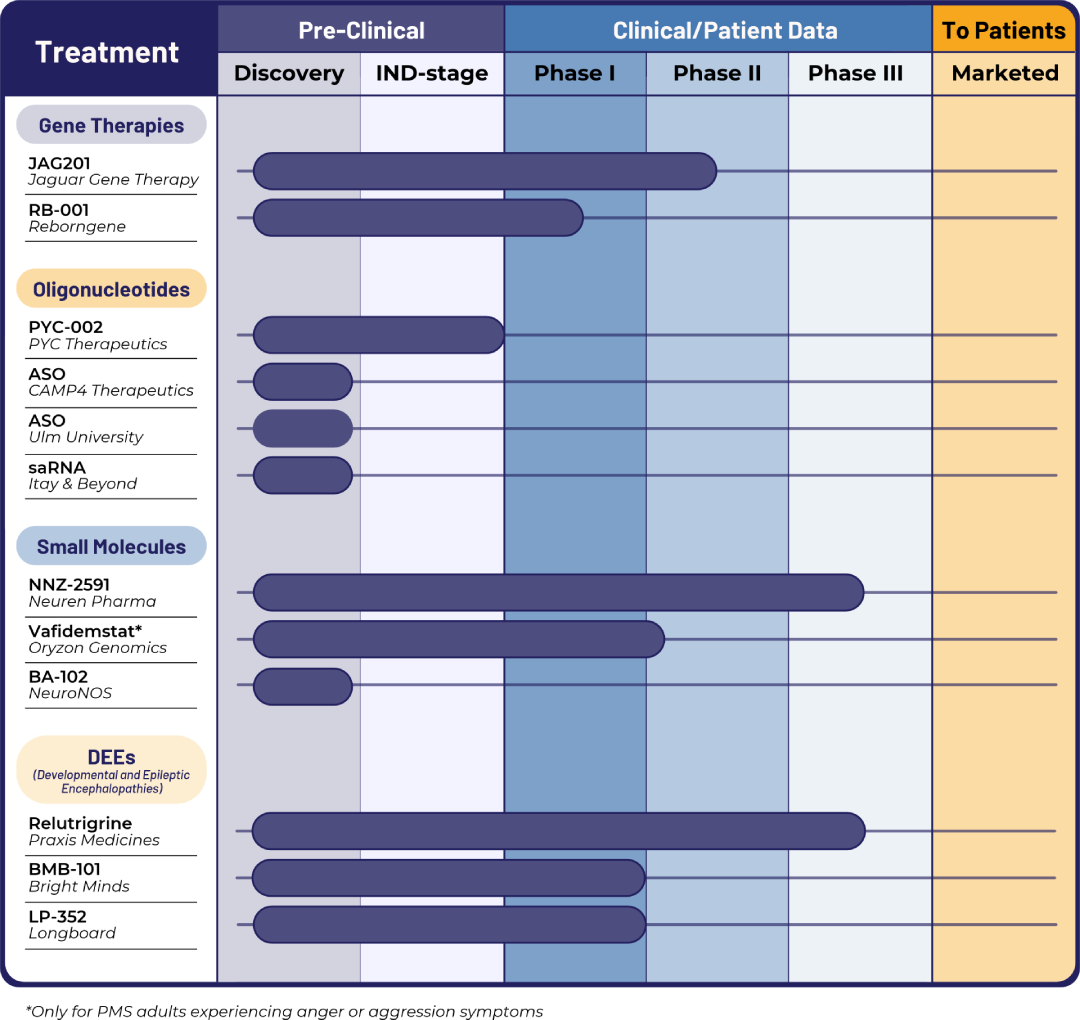
Jaguar has advanced JAG201 into a first-in-human clinical trial evaluating its safety, tolerability, and potential clinical effects.
In July 2026, Jaguar reported that:
Seven children had received JAG201 across three clinical trial sites.
No treatment-related serious adverse events had been reported.
Early signs of potential benefit had been observed in communication, motor, cognitive, and social development.
These early observations are encouraging, but they do not yet establish that JAG201 is safe and effective. Additional research and longer-term follow-up are necessary.
-
What could this mean for families?
Unlike treatments designed to manage individual symptoms, JAG201 aims to address the underlying SHANK3 deficiency.
If successful, this approach could potentially improve multiple areas of functioning. However, researchers still need to understand which individuals may benefit, how much improvement is possible, and whether any benefits are sustained over time.
-
What happens next?
Jaguar's clinical trial continues to evaluate safety and potential treatment effects. The company is also supporting research into developmental milestones to help researchers better understand meaningful changes in people living with PMS.
**Family participation:** The clinical trial has included children ages 2–9. Jaguar's separate Caregiver Milestone Study offers another way for eligible families to contribute to research.
*JAG201 is investigational and has not been approved as a treatment for PMS.
PYC Therapeutics (PYC-002)
Helping the body produce more SHANK3 protein
-
What is PYC developing?
PYC Therapeutics is developing an investigational RNA-based treatment for Phelan-McDermid syndrome (Antisense oligonucleotide (ASO) therapy) designed to increase production of SHANK3 protein.
Many individuals with PMS have one functioning copy of the SHANK3 gene and one copy that is missing or disrupted. PYC's approach aims to help the remaining functioning copy produce more SHANK3 protein.
The treatment uses an antisense oligonucleotide, or ASO, a short, specially designed molecule that interacts with RNA to influence how cells produce proteins.
Unlike gene replacement therapy, this approach seeks to increase SHANK3 production using the genetic material already present in the body.
-
Where does the research stand?
PYC has been advancing its SHANK3-targeted treatment through preclinical research and preparations for human clinical studies.
CureSHANK highlighted PYC's work at the 2025 American Society of Gene & Cell Therapy meeting, where the company presented its scientific approach and development plans.
At that time, PYC anticipated moving toward clinical testing in the second half of 2026, subject to development and regulatory progress.
The program has also been discussed in CureSHANK's drug development symposium and community education activities.
-
What could this mean for families?
The goal of increasing SHANK3 protein is to address a fundamental biological problem associated with PMS.
If successful, this strategy could offer a treatment option that works differently from gene replacement therapy. However, it is not yet known whether increasing SHANK3 protein through this approach will translate into meaningful improvements in daily functioning.
-
What happens next?
Key next steps include advancing clinical development, establishing safety, and determining whether the treatment produces the intended biological effects in people with PMS.
Observational research and other studies may also help inform clinical trial design and identify meaningful outcomes for families.
**Family participation:** Families interested in future research opportunities should follow updates from PYC and CureSHANK. Eligibility, locations, and enrollment timelines must be confirmed through the study sponsor.
*PYC's SHANK3-targeted therapy is investigational and has not been approved for PMS.*
Neuren Pharmaceuticals (ercanetide NNZ-2591)
Improving how brain cells function
-
What is NNZ-2591?
Neuren Pharmaceuticals is developing ercanetide (NNZ-2591), an investigational oral medication designed to improve how nerve cells communicate and function.
Unlike gene therapies that aim to restore SHANK3 protein, NNZ-2591 targets biological processes affected by SHANK3 deficiency.
The medication is designed to support communication between nerve cells and reduce inflammation in the brain, potentially improving developmental and behavioral functioning.
Because it is an oral medication, this approach differs significantly from treatments that require delivery directly into the body through specialized procedures.
-
What have researchers learned?
Neuren completed a Phase 2 clinical study in children with PMS, reporting encouraging improvements across measures of functioning.
The findings provided support for advancing the medication into a larger Phase 3 clinical trial.
Importantly, the Phase 2 study was open-label, meaning participants and researchers knew the children were receiving the investigational medication. A larger, placebo-controlled study is needed to determine whether the improvements were caused by the treatment.
-
Where does the research stand?
Neuren's Phase 3 Koala Study began dosing participants in February 2026.
The study is designed to evaluate approximately 160 children ages 3–12 with genetically confirmed PMS.
Participants are randomly assigned to receive either NNZ-2591 or a placebo for 13 weeks. Researchers are evaluating safety and whether the medication improves how children feel and function.
An open-label extension study is also designed to evaluate longer-term treatment effects among eligible participants.
-
What happens next?
The Phase 3 Koala Study will provide more rigorous evidence about whether NNZ-2591 is safe and effective.
**Family participation:** The Koala Study is evaluating children ages 3–12 with genetically confirmed PMS. Families can contact Neuren at medicalinformation@neurenpharma.com to learn about study eligibility and participating locations.
*NNZ-2591 is investigational and has not been approved for treating PMS.*