Recently, I had the opportunity to spend a week in China with a group of scientists, clinicians, and business leaders at the invitation of the Chinese Society for Cell and Gene Therapy (CSGCT). The visit was organized around the CSGCT Annual Scientific Meeting in Beijing, a rapidly growing event that welcomed more than 5,000 attendees this year. I was grateful for the chance to present on Phelan‑McDermid syndrome (PMS) and share CureSHANK’s efforts to accelerate therapeutic strategies. It was encouraging to see strong interest from the largely Chinese audience in genetic medicine approaches for a rare neurodevelopmental disorder, especially since most neurology‑focused presentations centered on more common neurodegenerative diseases.
Before the meeting, I had connected with a local PMS parent leader who arranged for a group of parents from several major cities to attend my talk and join me for lunch afterward. We were also joined by a neuroscience PhD student and an English teacher who helped facilitate translation during a long and meaningful conversation about PMS—over plates of Peking duck. I was struck by how knowledgeable, thoughtful, and engaged the parents were, and by how eager they were to discuss emerging therapies and how clinical trials for PMS might one day be accessible to their children. Despite differences in language and geography, their hopes and concerns were familiar. They were parents looking for answers, opportunities, and a better future for their children - the same hopes that drive CureSHANK’s work every day.
Early and widespread use of whole‑genome sequencing in China has dramatically increased the number of individuals being diagnosed and seeking treatment options, including children as young as two years old. As awareness and diagnosis have grown, so too has interest in potential treatments. Most of the families I met had young children, and they expressed a very strong interest in participating in research and future clinical trials.
There is a significant need for therapeutic innovation in countries like China, where healthcare budgets are limited and U.S.-developed therapies may remain out of reach. Encouragingly, the Chinese government has acknowledged this need by prioritizing the development of advanced genetic therapies in its new five‑year plan and by overhauling regulatory systems to ensure streamlined processes, high standards, and stronger patient protections. Numerous initiatives are emerging across Chinese academic, clinical, and biotech communities. With this momentum, optimism, and willingness to tackle complex rare neurodevelopmental disorders, there is hope that new treatment options will begin to take shape.
For CureSHANK, this is also part of a much broader goal. We want advances in precision medicine for PMS to reach families around the world—not only those who happen to live near the first clinical trial sites or in countries where a therapy is initially developed. As new treatments move forward, CureSHANK intends to work with families, researchers, clinicians, industry, and patient organizations across regions to help build the awareness, clinical trial readiness, and partnerships needed to make those opportunities as globally accessible as possible.
During my visit, I also met with staff from a Chinese nonprofit, Hope for Rare, which has been tirelessly supporting the rare disease community through awareness efforts and by facilitating research and technical development programs. CureSHANK is planning to partner with Hope for Rare to host the first Asia‑Pacific Phelan‑McDermid Syndrome conference in China next year, with the goal of further accelerating PMS research and therapeutic development throughout the region.
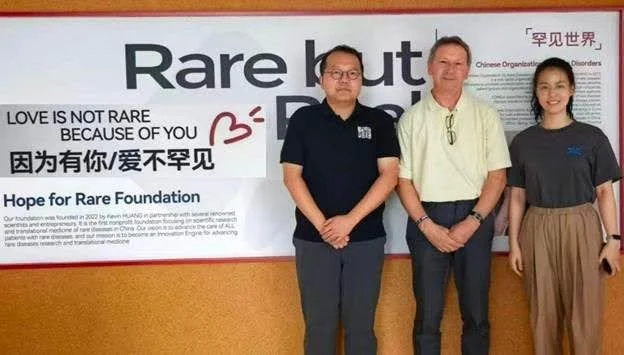
Ralf Schmid with Hope for Rare staff members Wenjun Zhang (left) and Wenhan Geng (right)
Ralf Schmid is the Chief Scientific Officer (CSO) at CureSHANK and can be reached at research@cureshank.org
